
Most dining room tables live two very different lives. There is the dressed-up version that comes out for Thanksgiving and dinner parties, and then there is the everyday version where mail stacks up and things get set down on the way through. If your table only looks good a few times a year, I want to show you that it does not have to be that way.
A beautifully styled dining room table does not require a special occasion. It requires a few intentional decisions that you make once, and then the table basically takes care of itself. Here is exactly how I approach it, including what I did in my own dining room.
Start With the Room, Not Just the Table
Before you think about what goes on the table, think about what surrounds it. A dining table does not exist in isolation. It is in conversation with the lighting above it, the art on the walls, the buffet or sideboard nearby, and the room's overall color story. When those elements are working together, your table can be very simply styled and still feel completely elevated.
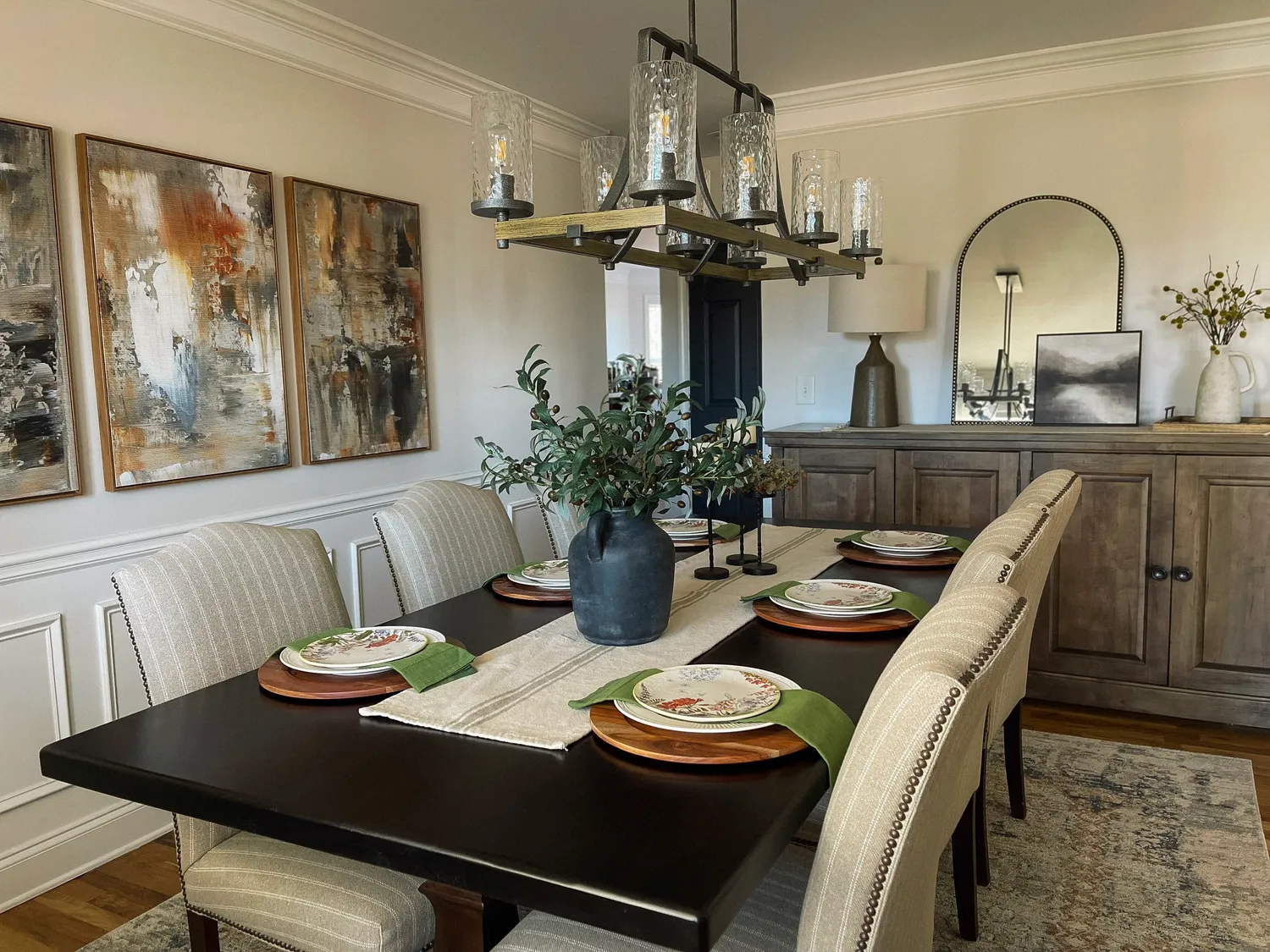
In my own dining room, the table has a dark finish, the chairs are upholstered in a warm neutral linen, and the buffet is a weathered wood tone. The abstract art on the wall carries the same earthy rust, charcoal, and warm gray tones throughout the room. When everything in the room is already working together, styling the table becomes much simpler because the room itself is doing a lot of the heavy lifting.
Ask yourself: do the art, the lighting, the sideboard, and the table all feel like they belong to the same story? If not, that is the first thing to address before you add a single centerpiece.
Anchor the Table With a Meaningful Centerpiece
The centerpiece is the heart of the table, but it does not have to be elaborate. The most beautiful everyday centerpieces are simple, organic, and grounded in something real. My favorite approach is a generous vessel with something that feels alive in it, a branch, loose greenery, or a handful of stems that bring the outside in.I use a large navy blue ceramic pitcher with olive branches. That combination works beautifully year-round. The pitcher has visual weight and personality. The olive branches are both organic and architectural. The whole thing took about five minutes to put together and has stayed on my table for months.
- A few everyday centerpiece combinations that always work:
- A ceramic or stoneware vessel with olive branches, eucalyptus, or loose greenery from your yard
- A wooden dough bowl with seasonal fruit and a few pillar candles alongside
- A simple crock with a single type of flower in a generous bunch
- A cluster of mismatched candlesticks at varying heights, with nothing else
Add Candlelight as a Non-Negotiable
Candles are not just for dinner parties. They are one of the single most transformative things you can add to an everyday table, and they cost almost nothing to maintain. Even unlit, a pair of pillar candles on iron or brass candlesticks alongside your centerpiece adds visual weight, warmth, and intention to the table. When you do light them for a weeknight dinner, the whole room shifts.
On my table, I keep two pillar candles on iron candlestick holders flanking the centerpiece. They balance the composition and give the table a sense of symmetry without feeling stiff. It is one of the simplest things I have done and one of the most effective.
Use a Runner to Ground the Whole Thing
A table runner does something that centerpieces alone cannot do: it connects everything on the table into one intentional composition. Without a runner, a centerpiece can feel like it is just sitting on a surface. With a runner, it becomes part of a styled moment.
Choose a runner in a natural material, such as linen or cotton, or with a woven texture. Neutral tones work best because they do not compete with your centerpiece or your dishes. My dining room runner is a soft stripe in warm linen tones that reads as almost neutral but adds just enough texture to make the table feel layered.
Let the runner extend slightly past the ends of what is on the table. A runner that is too short looks like an afterthought. One that runs nearly the full length of the table looks intentional and generous.
Set the Table Simply, Even on Ordinary Days
This is the one that surprises people most. Setting a beautiful table on a Tuesday is one of the simplest ways to make your home feel like a place you are proud of. It does not require fine china or elaborate napkin folds. It requires a few intentional pieces placed with care.
- A charger or wooden round as the base plate for each place setting
- A dinner plate layered on top, whether everyday stoneware or something with a little personality
- A cloth napkin folded simply and tucked under the plate or alongside it
- Flatware is placed intentionally, not tossed down
- Real glassware rather than plastic cups whenever possible
That combination takes about three minutes per place setting and looks completely different from dishes just stacked on the table. The charger is the single biggest upgrade. It adds layering, visual weight, and intentionality to even the most ordinary dinner plate.
Let Your Sideboard or Buffet Support the Table
If you have a sideboard, buffet, or console near your dining table, style it to support the room's overall feel rather than treating it as a separate decorating project. The two should feel like part of the same story.On my buffet, I keep a large table lamp for layered lighting, a piece of artwork that echoes the tones in the larger art wall, and just a few objects. Nothing is overcrowded. The lamp is especially important because it provides the dining room with warm, layered light at multiple levels, rather than relying solely on the overhead chandelier.
Think of the sideboard as a supporting actor. It should enhance the main scene without stealing attention from the table itself.
The Lighting Above the Table Changes Everything
A dining room with the right chandelier or pendant immediately feels more intentional than one without. The fixture above a dining table is one of the most important design decisions in the whole room because it is both functional and sculptural.
And always, always use warm bulbs. The difference between a cool white bulb and a warm one is the difference between a dining room that feels like a doctor's office and one that feels like somewhere you actually want to linger after dinner.
The Most Common Everyday Table Mistakes
- A centerpiece that is too tall for conversation. If guests have to lean around it to see each other, it belongs somewhere else.
- Too many small objects rather than one or two strong ones. Edit down. Always.
- Artificial flowers and greenery that look artificial. If you are going to use faux, invest in quality. Low-quality faux plants undermine everything around them.
- No texture on the table. If every surface is smooth and flat, the table will feel cold regardless of how well it is arranged.
- Ignoring the dining room between dinner parties. A beautiful everyday table is one of the easiest ways to make your whole home feel more intentional and cared for.
Your Table Is Worth Styling Every Day
The dining room table is one of the most used and most seen surfaces in your entire home. It deserves more than being a landing zone for mail and backpacks between special occasions. When it is styled with even a little intention, it changes the entire room's feeling and signals to everyone who walks in that this is a home where beauty and hospitality are part of everyday life.
If you found this helpful, save it for later. These are the kinds of principles worth coming back to whenever you refresh your dining room.
With love,
Simple Things Made Beautiful